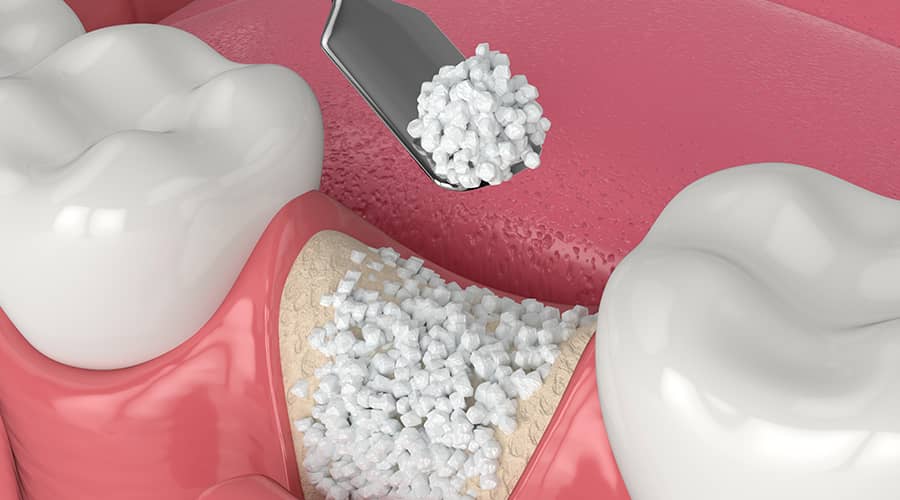
Also called autografts, these are taken from your own body, typically the chin, jaw, leg, hip, or skull. Because the graft is made from your own living bone, it promotes natural bone growth and is fully biocompatible. However, a second procedure is needed to harvest the bone, which may not be ideal for every patient.
Allografts come from human donors. The bone is processed and freeze-dried to ensure safety. It doesn’t contain living cells, so it serves as a scaffold for your own bone to grow into, rather than generating new bone on its own.
Several synthetic alternatives to natural bone are safe and effective, offering additional treatment options:
Derived from processed donor bone, DBM contains proteins and collagen that help support bone regeneration. It is available as powder, chips, or gel.
These blend materials like DBM, collagen, ceramics, or even autograft bone to enhance both structural support and biological activity.
BMPs are naturally occurring proteins that help regulate bone formation. In grafting procedures, they may be added to stimulate bone growth at the graft site.
Synthetic and composite materials reduce the need for bone harvesting, minimizing risk and discomfort. Each option has its pros and cons. Your oral surgeon will evaluate your specific needs to recommend the best grafting material for your treatment plan.
Proudly serving Tulsa County & surrounding areas:
Broken Arrow, OK • Jenks, OK• Supalpa, OK• Coweta, OK, • Owasso, OK• Bixby, OK• Claremore, OK• Wagoner, OK• Sand Springs, OK• Skiatook, OK• Bartlesville, OK