
Exposure of Impacted Teeth
When a tooth becomes impacted—unable to erupt into the mouth properly—oral surgery may be needed to help guide it into place. This is especially common with upper canines (eyeteeth), which are essential for both bite alignment and aesthetics. Early diagnosis and timely intervention are key to successful treatment.
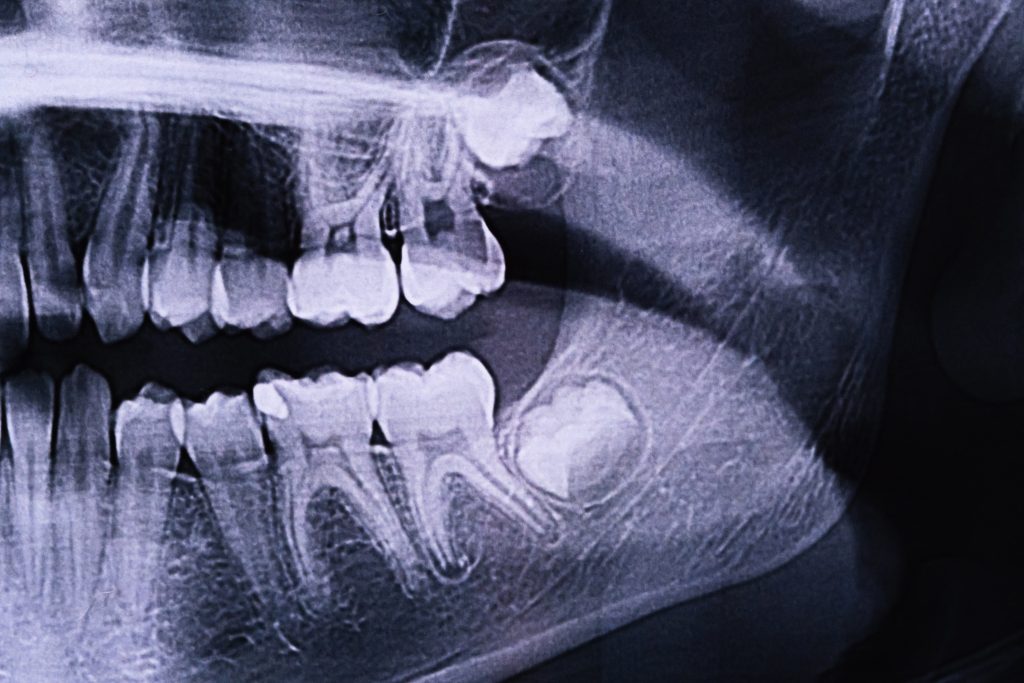
Panoramic X-ray
Guiding Impacted Teeth Into Position
Impacted teeth, especially upper canines, often require a collaborative treatment involving both your orthodontist and oral surgeon. Using a precise surgical procedure, the tooth is uncovered and a small bracket is placed to gently guide it into its natural position over time—restoring both function and appearance.
An impacted tooth is one that is “stuck” and cannot erupt into its proper position in the mouth. This is most commonly seen with third molars (wisdom teeth), which often fail to emerge properly and can cause pain, infection, and other oral health issues. (See Wisdom Teeth for more details.)
The second most frequently impacted tooth is the maxillary cuspid (also known as the upper eyetooth). This tooth is critical for your bite, having the longest roots of any human teeth and playing a key role in guiding the alignment of the rest of your teeth when your jaws close together.
Maxillary cuspids typically erupt around age 13 and help close any space left between the upper front teeth. If a cuspid becomes impacted, it may require assistance to erupt properly. This can apply to other impacted teeth as well, but the techniques are most commonly used for maxillary cuspids. Approximately 60% of impacted eyeteeth are located on the palate (roof of the mouth), while others may be embedded in bone or displaced toward the facial side of the dental arch.
Identifying impacted teeth early greatly increases the chances of successful treatment. A panoramic x-ray and clinical exam can confirm whether all adult teeth are present or if some are missing. For younger patients, early detection allows for intervention before the impacted tooth becomes fused in place.

Treatment may involve extracting over-retained baby teeth or adult teeth blocking eruption, and removing supernumerary teeth or other obstructions. These procedures are typically performed by an oral surgeon.

Success Rates by Age

  • 11–12 years old: If space is opened, there is a good chance of spontaneous eruption.
  • 13–14 years old: The eyetooth likely won’t erupt without surgical assistance.
  • Over 40 years old: The tooth is often fused and may need to be extracted and replaced with a dental implant or bridge.

When the Tooth Won’t Erupt

In cases where an impacted tooth doesn’t erupt on its own, a collaborative approach between an orthodontist and an oral surgeon is used. The surgeon will surgically expose the tooth and attach a bracket and chain to it. The orthodontist then applies gentle traction over time to guide the tooth into position.

The goal is to bring the impacted tooth into the dental arch, not remove it. After the tooth erupts, minor gum surgery may sometimes be needed to improve the health or appearance of the surrounding tissue.

Surgical Procedure Overview

The exposure and bracketing procedure is typically performed in-office using local anesthesia and laughing gas. Some patients may opt for IV sedation, although it is usually not necessary. If the procedure only involves exposing the tooth without placing a bracket, the procedure is even quicker.

Details will be reviewed during your preoperative consultation. For more information, please refer to our Preoperative Instructions.

If you have questions or wish to schedule a consultation, contact our office today.