77 Vilcom Center Dr., Suite 120, Chapel Hill, NC 27514

(918) 609-2020

Menu

Reviews

For Patient

Call US

Nerve Repositioning

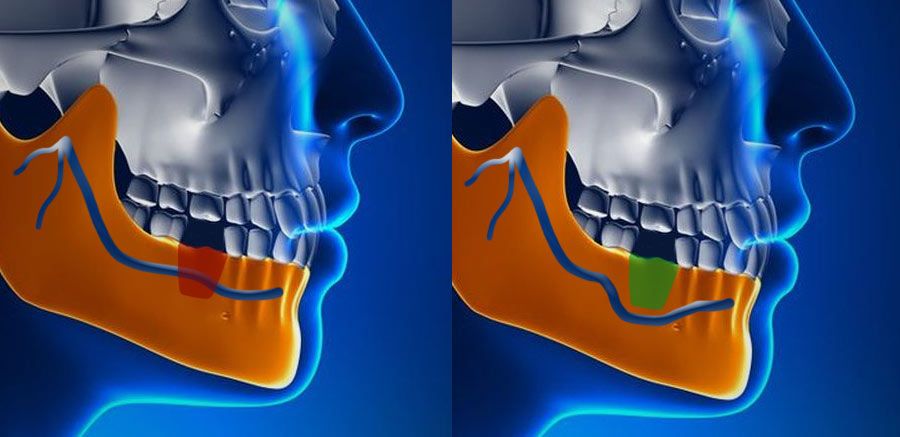
The inferior alveolar nerve, which gives feeling to the lower lip and chin, may need to be moved in order to make room for the placement of dental implants in the lower jaw. A nerve repositioning procedure is limited to the lower jaw and may be indicated when teeth are missing in the area of the two back molars and/or second premolars. This procedure is considered a very aggressive approach since there is almost always some postoperative numbness of the lower lip and jaw area, which typically dissipates very slowly, but may be permanent. Usually other, less aggressive options are considered first (placement of blade implants, etc).
Nerve Repositioning
How Is Nerve Repositioning Performed?
Typically, we remove an outer section of the cheek on the side of the lower jaw bone in order to expose the nerve and vessel canal. We then isolate the nerve and vessel bundle in that area and slightly pull it out to the side. We then place the implants while tracking the neuro-vascular bundle. Then the bundle is released and placed back over the implants. The surgical access is refilled with bone graft material of the surgeon’s choice and the area is closed.
These procedures may be performed separately or together depending upon the individual’s condition. As stated earlier, there are several areas of the body that are suitable for attaining bone grafts. In the maxillofacial region bone grafts can be taken from inside the mouth, in the area of the chin or third molar region, or in the upper jaw behind the last tooth. In more extensive situations a greater quantity of bone can be attained from the hip or the outer aspect of the tibia at the knee. When we use the patient’s own bone for repairs or additions, we generally get the best results.
In many cases, we can use allograft material to implement bone grafting for dental implants. This bone is prepared from cadavers and is used to get the patient’s own bone to grow into the repair site. It is quite effective and very safe. Synthetic materials can also be used to stimulate bone formation. We even use factors from your own blood to accelerate and promote bone formation in graft areas. These surgeries are performed in the out-office surgical suite under IV sedation or general anesthesia. After discharge, bed rest is recommended for one day, as well as limited physical activity for one week.

Trusted Expert in Advanced Oral and Maxillofacial
Surgery

At Riverside Oral & Maxillofacial Center, we offer a wide array of oral surgery treatments to patients throughout the Riverside area and nearby regions. Our goal is to enhance both the appearance and functionality of your smile. Led by board-certified oral surgeon Dr. Emily Carter, our skilled team performs advanced procedures including dental implants, full-arch restorations, wisdom tooth extractions, and more. We prioritize your safety and comfort with modern facilities, cutting-edge technology, and a dedicated on-site anesthesia team.

Get in Touch Cherry Street Oral & Facial Surgery

You can reach our office in several convenient ways. Choose the option that works best for you.

Our Mailing Address

Cherry Street Oral & Facial Surgery

77 Vilcom Center Dr., Suite 120, Chapel Hill, NC 27514

Tulsa

Oklahoma

74120

Mon – Thu: 9:00am – 5:30pm
Friday: 9:00am – 2:00pm
Saturday: Closed
Sunday: Closed

Contact Numbers

Phone: (918) 609-2020
Fax: (987) 654-3210